
What Nigerian Buyers Lost When BlackBerry Fell | Virall.Live
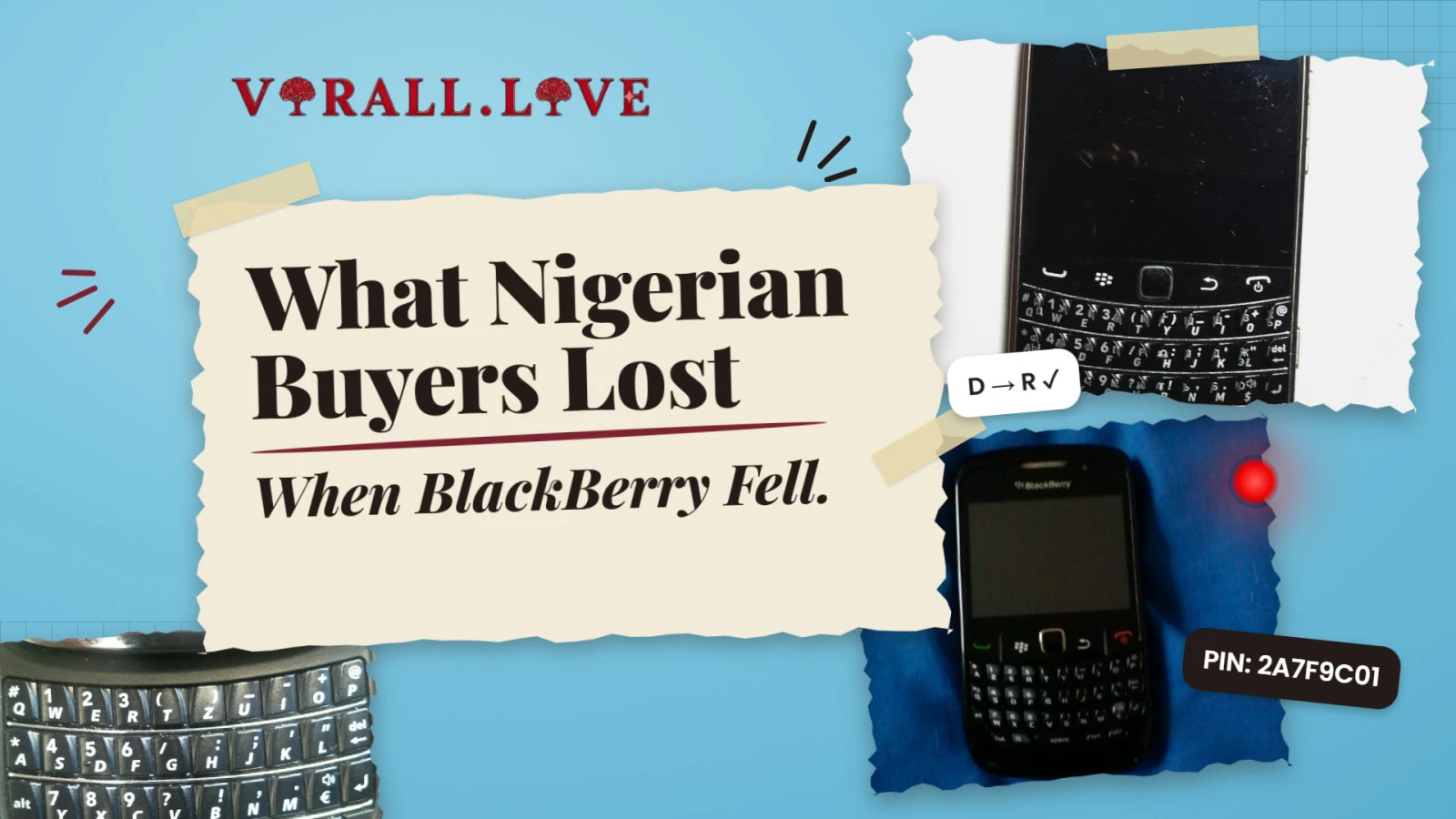
Before WhatsApp, we had a PIN and a status. Then it went silent. And with it went years of conversations nobody could export. What did we lose?
Visualize a lecture hall, a church service, a bus on the bridge. Somewhere in the room a small red light is blinking at the corner of a phone. Someone is bent over a tiny keyboard, thumbs moving fast. You did not need to see the screen. You knew what that light meant: someone had sent a message.
The phone that felt like belonging
BlackBerry was never just a phone in Nigeria. It was a membership card. It came in a range, from the cheaper Curve to the Bold, and industry watchers noted that high-end models like the Bold 9900 sold as well as the inexpensive Curve 8520. A student and a banker could carry different phones and still be on the same network of friends. The trackpad under your thumb, the full keyboard and the shortcuts you used without thinking became muscle memory.
Your PIN was your identity
Before we handed out phone numbers freely, we handed out PINs. BBM created its own rituals: exchanging PINs, delivery and read receipts, and broadcast messaging. "Pin me" was an invitation. Scanning someone's barcode felt like a handshake. You did not just meet someone, you added them, and that small act felt like being let into a circle.
D and R, the two letters that ran relationships
Remember the D that appeared when your message was delivered, and the R that came when it was read? Those two letters carried more drama than most soap operas. An R with no reply was a statement. Waiting for the R to show up was a sport. The "typing" notice made you hold your breath, and the Ping, the shake of the whole chat, was how you demanded attention from someone who was ignoring you.
The status was your headline
Your BBM status was your front page: a song lyric, a Bible verse, a quiet shot at someone, or just "busy". Your display picture was your campaign poster. For some people it was even how they found new music, with one writer recalling discovering artists from seeing them on BBM statuses.
Then there was the broadcast message, the digital chain letter that reached every contact at once. "Please add me" and "forward this to everyone on your list" were everywhere. You either loved them or muted them, but you knew them.
The group chat that ran campus life
On Nigerian university campuses, BBM groups were used to organise academic discussions, social events and even activism, which put the platform deep inside youth culture. The early BBM Groups had a limit of 30 people, which was enough for a class, a church cell, a family, or the squad planning the weekend.
It felt like living with your people
BBM did not only connect you to friends. It made you feel like you lived in the same house as everyone you cared about. Your family group, your church people, your classmates and that one cousin who broadcast everything were a tap away, and they were awake at the same time. Good morning messages arrived before you got out of bed. Someone always had news and someone always had a plan. You could be alone in your room and still feel like the compound was full. That sense of being surrounded is what many Nigerians miss most. Today we have more apps and more followers, but fewer places that feel like home.
Free chat in a world of expensive texts
Part of the appeal was price. BBM offered free instant messaging and group chats at a time when SMS costs were high and alternatives were limited. An industry note from the Curve and Bold era reported that 97% of BlackBerry users in Nigeria were using BBM. People were not only buying a phone, they were buying access to everyone they knew.
How big it really was
The numbers were large. In 2011, reports put BlackBerry users in Nigeria at about 1.5 million and growing. Years later, when BlackBerry was no longer the star, figures reported in 2017 counted 4.3 million BBM users in Nigeria who spent more than nine hours a week messaging. Even in decline, people were still there.
BBM also touched things that look familiar today. BlackBerry partnered with Interswitch to let BBM users send money to each other, a small preview of the fintech boom that followed.
The slow goodbye
The fall did not happen in one day. WhatsApp offered something BBM did not at first: messaging across any phone, without staying inside BlackBerry's closed system. When BBM finally reached Android and iPhone, it removed one of the last reasons to buy BlackBerry hardware. BlackBerry began pulling out of the phone market in 2016.
Then came the dates that closed the book. The consumer version of BBM shut down on May 31, 2019, after nearly 14 years. On January 4, 2022, BlackBerry switched off its legacy services, so classic BlackBerry phones stopped working as they had.
Where are they now?
The name did not disappear. It changed jobs. Here is what became of the company, the people who ran it and the phones we loved.
The company: from phones to software
BlackBerry is still a listed company in Waterloo, Ontario, and it no longer makes phones. Under CEO John Chen, who took over in November 2013, it moved from handsets to software for cybersecurity and the Internet of Things. By 2020 it had left the phone market entirely. It bought the security company Cylance in 2018 for $1.4 billion, and later sold that business at a large discount.
The part that grew is QNX, BlackBerry's operating system for machines. In its April 2026 results, BlackBerry said QNX is embedded in more than 275 million vehicles worldwide, with growing interest in robotics and what it calls physical AI. In its latest results, reported on September 24, 2026, revenue rose 26% year on year to $163 million, with record QNX revenue and the largest design win in QNX history. A car you ride in may be running BlackBerry software without you ever knowing.
The CEOs and the founders
The founders left first. Mike Lazaridis and Jim Balsillie stepped down as co-CEOs in January 2012, and Thorsten Heins took over. Lazaridis turned to science. He founded the Perimeter Institute for Theoretical Physics, and in 2013 he and co-founder Doug Fregin launched Quantum Valley Investments, a $100 million fund for quantum technology. Balsillie became known as a philanthropist and the founder of the Centre for International Governance Innovation and other non-profit organisations.
John Chen retired at the end of October 2023 after a decade as CEO. Richard Lynch stepped in as interim CEO and stayed on as chair, and John Giamatteo, who led the cybersecurity business, was named CEO in December 2023. He still holds the role as of the latest results in September 2026.
The people
This part is the least comfortable. Before Chen arrived, almost three years of layoffs had shrunk the workforce by 60 per cent. By October 2023 BlackBerry had about 3,200 employees. Under Giamatteo the company cut $150 million in yearly costs and reduced headcount by a further 37 per cent. The sources I found describe layoffs and restructuring, not a clear story of staff being moved from phones to new roles. What can be said is that the work that remains is software: security, secure communications and QNX.
The phones
BlackBerry handed its brand to TCL in 2016, and TCL made models such as the KEYone and the KEY2 until its licence ended in early 2020. A new licensee, OnwardMobility, announced a 5G keyboard BlackBerry in August 2020, but BlackBerry cancelled that licence in February 2022 and the phone was never released. BlackBerry also sold its remaining mobile patents for $600 million. The last official BlackBerry phone dates to 2018, yet in 2026 people still ask for one, which says a lot about how much the keyboard and the feeling mattered.
The Light Went Out, but the Feeling Stayed
BBM is gone, and the phones that carried it have long been retired. Today we have more ways to connect than we ever imagined. We can call, text, video chat, and send voice notes to anyone in the world, on almost any phone. Yet none of it quite feels the same.
There is something about BBM that still pulls at us, a feeling that takes us back to a simpler time. Some things you can switch off, but you cannot delete the memory of how they made you feel.
So before we close the chapter, what was your BBM status back then, and who was the last person you pinged?
Sources
BusinessDay Nigeria, on BBM and Nigerian youth culture: businessday.ng/?p=1085662
CrackBerry, on the Nigerian BlackBerry market: crackberry.com/blackberry-market-still-growing-nigeria
Brand Spur Nigeria, on BBM users in Nigeria: brandspurng.com (November 2017, BBM Messenger event)
TechSpot, on the consumer BBM shutdown: techspot.com/news/79717-consumer-version-blackberry-messenger-go-dark-may-31.html
Silicon Republic, on the end of BlackBerry legacy services: siliconrepublic.com/?p=957418
The NATIVE, on BlackBerry and Nigerian youth culture: thenativemag.com/blackberry-2-tech-nigeria
BlackBerry Limited, Form 8-K results, April 9, 2026 and September 24, 2026: sec.gov
Bloomberg and SiliconANGLE, on John Chen's exit and the CEO change, October and December 2023
The Globe and Mail, on the BlackBerry turnaround and headcount cuts, 2025
Technewsday, on the 60 per cent workforce reduction before 2013
Perimeter Institute, MIT Technology Review and The Canadian Encyclopedia, on Mike Lazaridis, Doug Fregin and Jim Balsillie
PhoneArena, SlashGear and TechRadar, on TCL, OnwardMobility and the end of BlackBerry phones
Discussion
Log in to join the discussion.
- Loading comments…