
2go: The App That Taught Nigeria to Chat, and Where It Is Now
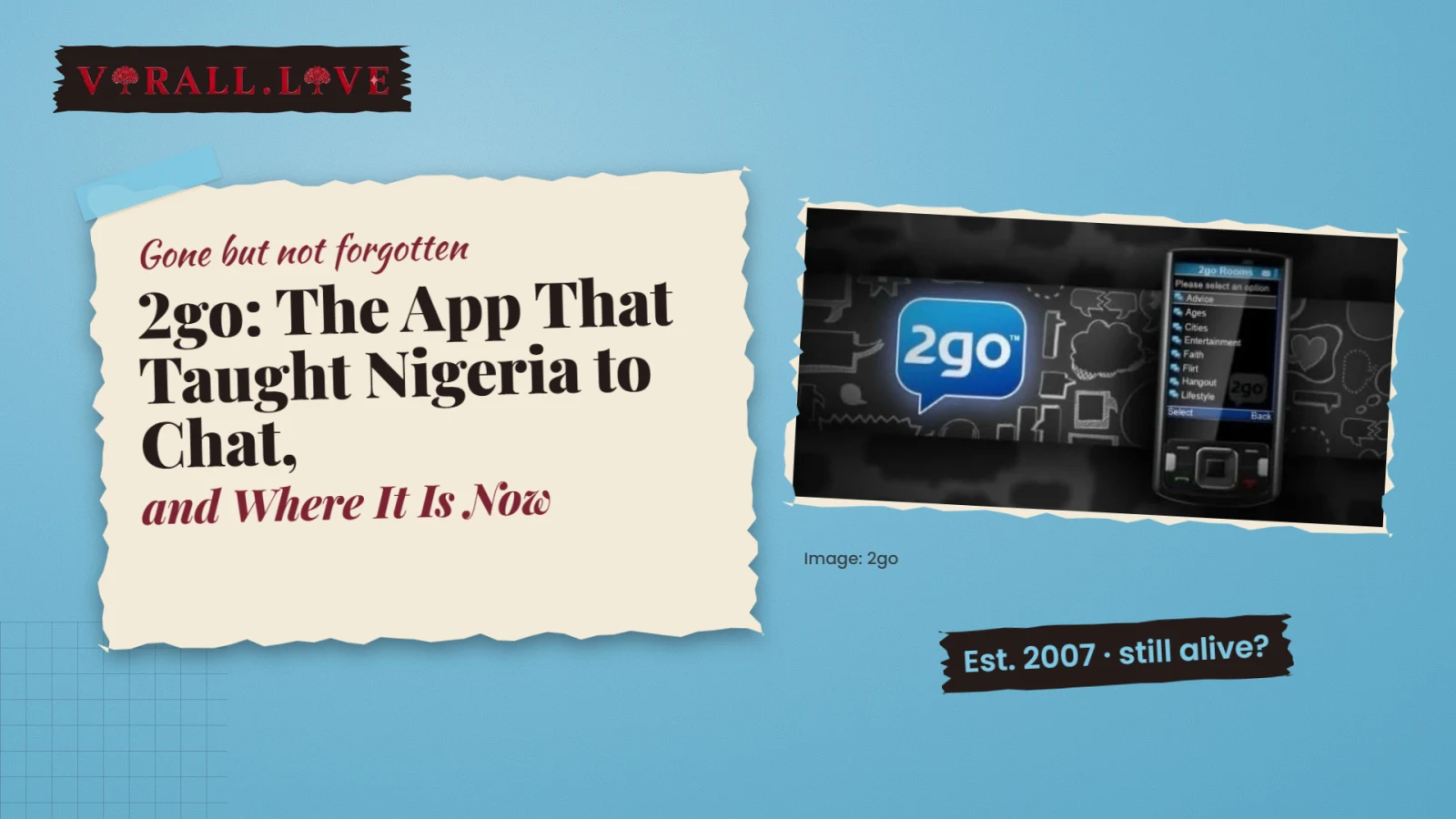
Somewhere in a drawer in Nigeria, there is an old Nokia or Tecno with a cracked keypad. If you could switch it on one more time, there is a good chance you would find a small icon on the screen: 2go.
Before WhatsApp, before Instagram, there was a little Java app that kept a generation awake at night. This is the story of 2go, what happened behind the scenes, and what is left of it today.
Somewhere in a drawer in Nigeria, there is an old Nokia or Tecno with a cracked keypad. If you could switch it on one more time, there is a good chance you would find a small icon on the screen: 2go.
For millions of young Nigerians between roughly 2010 and 2013, that icon was the whole internet. It was where you met people from other states, where you found out who liked you, and where you stayed up past midnight under your blanket, typing with your thumb and praying your mother would not hear the keypad.
Today, most of us have not opened 2go in more than ten years. But we never really forgot it.
What 2go was
2go was a chat app built for the phones most Nigerians actually had at the time: feature phones, the small, non-touchscreen phones that ran simple Java apps (Java was the software that let these basic phones run small programs and games). There was no need for an expensive smartphone. If your phone could browse, it could probably run 2go.
On it, you could:
Chat one-on-one with friends, and with strangers who quickly became friends.
Join chat rooms, crowded group conversations by topic and location. The company even created a chat room for each university in Nigeria.
Climb the ranks. The longer you stayed online, the higher your rank rose, and a high rank was a status symbol. Some students reportedly sneaked phones into school just to stay online and keep climbing.
Spend GoCredits, 2go's own in-app currency, used to buy content, play games and chat in rooms.
Pick a username that said everything about you, and some of those usernames were truly something.
It was also light on data. The company said it used its own compression technology to keep data use low, which mattered a great deal when every megabyte cost money.
Bigger than Facebook in Nigeria
In September 2012, 2go said it had over nine million active users in Nigeria, several million more than Facebook had in the country at the time. Across Africa, it reported more than 21 million registered users and about 50,000 new sign-ups every day.
The figures vary between reports, and they are the company's own numbers, but the picture is clear: for a few years, a small chat app was where young Nigeria lived online.
Behind the scenes: the surprise most Nigerians never knew
Many people assumed 2go was Nigerian. It was not. It was created in 2007 in Johannesburg, South Africa, by a group of computer science students at the University of the Witwatersrand. It started as a students-only mobile website before it grew into a chat app.
Nigeria became its biggest market, almost by accident. The company said it grew without ever paying for advertising and without taking a single cent of outside investment. People simply invited their friends, and their friends invited theirs.
It was not easy to build. 2go worked on about 800 different feature phone models. As its director, Peter Lockhart, put it in 2012: "It's much, much harder to develop for feature phones than for smartphones." Their mission, he said, was to make chat "easy, cheap and painless, no matter what device you're using."
For a seven-person company, that was a remarkable thing to pull off.
What went wrong
The same thing that made 2go great made it vulnerable. It was built for feature phones, and Nigeria was about to move on from them.
Android arrived. Cheaper smartphones flooded the market, and Java phones began to disappear.
The smartphone version did not feel the same. 2go released apps for Android and iPhone, but many users felt the experience could not match what they had loved.
WhatsApp delivered the final blow. It was simple, worked on every smartphone, and its group chats took over the role that 2go rooms used to play.
By 2018, reports said 2go had lost most of its users. There was no dramatic shutdown, no farewell message. People simply stopped logging in, one by one, until the rooms went quiet.
Where 2go is now
Here is the part many people do not know: 2go never fully shut down.
It is still run by the same company, 2go Interactive (Pty) Ltd, now based in Cape Town. The app lives on Google Play under a new name, "2go Chat – Chatrooms & Dating", presented as a chatroom and dating app. The old Java and BlackBerry versions that most Nigerians used are gone.
So the app is still there, but the 2go we remember is not. That 2go belonged to a moment: a generation discovering the internet on a small screen, one late-night message at a time.
What 2go taught us
Build for the phones people actually have. 2go won Nigeria by working on cheap phones, not by waiting for everyone to own a smartphone.
Even giants can fade quietly. 2go did not lose to a scandal. It lost to a shift in technology it could not keep up with.
Platforms change, people don't. We still want the same things: to belong, to be seen, and to talk to someone at 2am. Only the app has changed.
Final word
2go was more than an app. It was our first group chat, our first online crush, and for some of us, our first lesson in how fast technology moves on. The rooms are quiet now, but the memories are loud.
What was your 2go username? And what rank did you reach? Tell us in the comments.
Sources
Wikipedia, "2go" (accessed November 2026)
Gadget (World Wide Worx), "2go: the little app that could go far" (20 September 2012)
Ventureburn, "2go: SA startup you've never heard of crushes Facebook in Nigeria" (September 2012)
Jali Africa, "The biggest 'What If?' in the African Tech Space" (3 June 2022)
Google Play listing, "2go Chat – Chatrooms & Dating", 2go Interactive (Pty) Ltd
Discussion
Log in to join the discussion.
- Loading comments…